Fix it
Adjustable Dumbbell Weight Selection Mistakes: Buying Too Heavy, Too Light, or the Wrong Steps
Adjustable dumbbell weight selection mistakes that waste money and stall progress: one weight for pressing and rowing, a ceiling outgrown in a year, 10 lb jumps where 2.5 lb steps belong, and a single priced against a pair.
Adjustable dumbbell buying goes wrong before the first set, because the weight that is right for one movement is wrong for another, and the ceiling that looks generous on the box can be the end of the road in a year. A dumbbell you can row confidently is usually far too heavy to press overhead, and a dumbbell you can press for reps is usually too light to train a hinge or a heavy row. The adjustable dumbbell troubleshooting guide covers what goes wrong with the dumbbell itself, stuck dials, loose pins, rattles, and collar creep. This page covers what goes wrong with the choice: the sizing mistakes that leave owners with a dumbbell they cannot press, a set they outgrow in a month, or a step pattern that forces rounding on half their lifts. The ranked shortlist underneath it all is our best adjustable dumbbells guide.
Buying one weight for pressing and rowing
The press is a shoulder movement, so it tolerates a modest weight. The row is a back movement, so it wants a heavy one. Buyers who pick a single weight for both jobs usually pick the row weight, and then cannot press it safely for a single clean rep. Size the first dumbbell to the press, not the row: a dumbbell you can press overhead with control is the dumbbell that teaches the rest of the routine too, just with lighter load on the pulls. The BowFlex SelectTech 552 is the honest first buy here, because its 5 to 52.5 lb range with 2.5 lb steps below 25 lb covers the press for most home lifters, while a second, heavier handle can follow later. The PowerBlock Elite EXP is the other honest answer, because its Stage 1 pair runs 5 to 50 lb today and its stage kits reach 70 and then 90 lb on the same handles, so the press weight and the later row weight are the same system.
Buying the heaviest ceiling first
The 90 lb dumbbell looks like the last purchase you will ever make, until you try to press it. The BowFlex SelectTech 1090 starts at 10 lb and moves in 5 lb steps the whole way to 90 lb, which makes it a poor first dumbbell for anyone whose press lives under 25 lb: there is no 7.5 or 12.5 lb setting, and the low end is simply missing. The PowerBlock Pro 100 EXP has the same shape of problem at the top of the range, a 100 lb ceiling reached in stages from a lower base, which is a decade of progression only if the base weight suits you today. Buy the ceiling you will reach in year three, not the ceiling that impresses in the listing, and check the floor first: if the lightest setting is heavier than your press, the dumbbell is already wrong.
Ignoring the increment chart
Two dumbbells can both claim 5 to 55 lb and train completely differently. The Flybird DB2 verified in this guide steps 15, 25, 35, 45, 55 lb, five positions with 10 lb between them, so a lateral raise that needs 20 lb gets 15 or 25 instead. The BowFlex 552 steps 2.5 lb from 5 to 25 lb, then 5 lb to 52.5 lb, which is why small-muscle work progresses on it and stalls on the Flybird. The Core Fitness pair steps 5 lb across its 5 to 50 lb range, and both PowerBlock models carry 2.5 lb adder weights for the same fine work. Before buying anything, walk your current program through the model's actual weight chart: press, row, curl, raise. If the chart forces rounding on half your lifts, it is the wrong chart, whatever the box says.
Comparing a single's price to a pair's price
This category's oldest confusion, and the one that costs buyers real money: several flagship models are sold as one dumbbell. The PowerBlock Pro 100 EXP verified in this guide is sold as a single unit, as are the BowFlex 552 and 1090, while the Core Fitness set and the PowerBlock Elite EXP Stage 1 arrive as pairs. A single that looks cheaper than a pair usually is not, once the second dumbbell is added, and a pair that looks expensive is often the cheaper route to two-handed training. Check the listing's unit language, check whether a tray or cradle is included for each hand, and double the single's price before comparing. The spec tables in the best adjustable dumbbells guide mark the sold-as format for every model, and the buying guide works through the listing trap in full.
Buying a closed ceiling you outgrow in a year
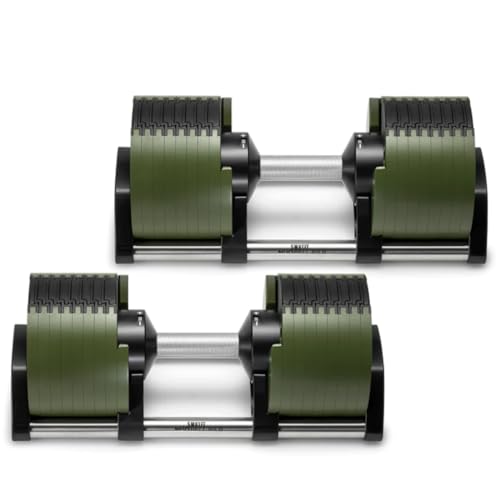
A 50 lb dumbbell that cannot grow is a rental with a one-year lease, and the bill arrives as a full replacement rather than an upgrade. The BowFlex 552 has no expansion path in the SelectTech line, so owners who pass 52.5 lb face the 1090 as a second purchase, which the buying guide calls the most expensive path of all when it happens. The PowerBlock Elite EXP is the opposite bet: Stage 1 gives a 5 to 50 lb pair today and a published path to 90 lb per hand with two kits, so the first purchase grows rather than dies. The SMRTFT Nuobell 580 sits between the two: no expansion kits, but an 80 lb ceiling that covers pressing and rowing for most home lifters without any second purchase. The question is not how much you lift today, it is how much you expect to lift in year three, and the answer belongs in the first decision.
Choosing dial speed for a drop-heavy routine
Dial and twist mechanisms are fast, and they are also the failure point owners report after drops. The BowFlex dial models carry plastic housings and plate tabs that do not tolerate drops onto hard floors, and the twist models in this guide share the same discipline: controlled set-downs only. If your routine ends sets by dropping the dumbbell, buy iron or steel instead. The Yes4All spinlock set, 105 lb of cast iron across a pair with star collars, treats drops as a non-event, and the PowerBlock steel plate stacks tolerate rougher handling than any dial while still preferring a controlled set-down. Mechanism choice is training-style choice, and the honest version of it is in the troubleshooting guide: a dial that sticks after a drop is a repair, not a warranty debate.
Expecting premium parts depth from a budget quick-adjust
The LifePro PowerFlow X 55 is the budget buy in this guide for a reason: a selector-set 5 to 55 lb quick-adjust dumbbell with a tray included, for notably less money than the premium benchmarks. What the lower price buys is a selector that feels less precise than the premium dials, tray clips and trim that feel budget grade, and long-term parts availability that is less certain than BowFlex or PowerBlock. None of that makes it a bad buy: for a first adjustable, a teenager's first dumbbell, or a second corner, it does the quick-adjust job for less. It becomes a mistake only when the buyer expects the premium brands' parts counter and support depth at the budget price, and then discovers the difference in year two. Buy the LifePro for what it is, and buy the BowFlex or PowerBlock when the parts question matters.
Buying a starter set as a main set
The Amazon Basics 38 lb set is 38 lb in total across two handles: two 3 lb handles, four 2.5 lb plates, four 5 lb plates, and four 0.5 lb collars in a carry case. That is the right first weights for light programs, older lifters returning to training, and physical therapy style work, and it is the wrong set for anyone already training with more than about 20 lb per hand. Younger beginners outgrow it in months, and there is no expansion path: heavier training needs a new set, not a new plate. The Yes4All spinlock set is the honest alternative at the same end of the price ladder, because its standard plates can be added cheaply as strength grows. Buy the starter set for the program it actually serves, and let the budget guide show what the next step up costs.
Still stuck? Compare the current top picks
Full ranked list

FAQ
Adjustable Dumbbells questions, answered straight
What weight should a beginner start with?
Start with the weight you can press overhead with control and swing, row, or curl with a clean pattern, not the weight you can deadlift. If you are choosing between two weights and unsure, take the lighter one: a dumbbell that is slightly too light still teaches the movement, while a dumbbell that is too heavy teaches compensation. The best adjustable dumbbells guide ranks first buys by exactly this logic, and its ceiling FAQ gives the same answer in short form.
Is one dumbbell enough, or do I need a pair?
One dumbbell trains one side at a time and covers rows, presses, and goblet work honestly, which is why singles like the BowFlex 552 and the PowerBlock Pro 100 EXP sell as well as they do. A pair trains both sides together and is the only honest option for barbell-style pressing and for circuits where swapping hands wastes the clock. The cost question is the sold-as question: the Core Fitness pair and the PowerBlock Elite EXP Stage 1 arrive as pairs, while the BowFlex models and the Pro 100 EXP are singles, so double the single's price before comparing.
When should I go heavier?
When the current ceiling is the limit on your strongest movement with clean form, not when a calendar says so. If rows at the top setting feel light and the press still has room, the ceiling has arrived: buy the next stage kit on an expandable system like the Elite EXP, or plan the replacement on a closed system like the 552. If the heavier weight pulls your form apart, go back down a setting and keep training, because the jump was the mistake, not the ambition.
Are 2.5 lb steps really worth paying for?
For shoulders, arms, and rehabilitation style work, yes, because early isolation strength grows in small units and a 5 lb jump on a 15 lb lateral raise is a third more load in one step. The BowFlex 552 gives 2.5 lb steps from 5 to 25 lb, and both PowerBlock models carry 2.5 lb adder weights for the same reason. For big presses and rows above 40 lb, 5 lb steps are standard and workable, which is why the 1090 and the Nuobell get away with them. Pay for the fine steps where your weakest lift lives.
Can I mix a dial and a spinlock set?
Yes, and mature home gyms often do: a dial or twist adjustable for circuits and follow-along work where change speed matters, and a spinlock iron set for heavy straight sets and anything that gets dropped. The two systems answer different questions, so the only mistake is expecting one of them to answer both. The home gym guide shows how the two classes share one corner without fighting over it.