Head to head
ProForm Carbon T7 vs Horizon T202 (2027): Screen or Belt?
Two mid-tier folders compared: iFIT classes and an assisted fold against a longer belt, dial controls, and subscription freedom.
ProForm Carbon T7 Smart Treadmill vs Horizon T202 Treadmill: the specs, side by side
| Spec | ProForm Carbon T7 Smart Treadmill | Horizon T202 Treadmill |
|---|---|---|
| Motor | 2.6 CHP class | 2.75 CHP (Johnson Drive System) |
| Speed range | 0-10 mph | 0.5-12 mph |
| Incline | 0-10% | 0-12% |
| Belt size | 55 x 20 in | 60 x 20 in |
| Capacity | 300 lb | 325 lb |
 ProForm
 Carbon T7 Smart Treadmill
iFIT folding runner with a 7-inch HD touchscreen and an assisted deck lower.
- Motor: 2.6 CHP class
- Speed range: 0-10 mph
Sources: ProForm Carbon T7 product documentation, Amazon listing specifications
Check price on Amazonor add to your Amazon cart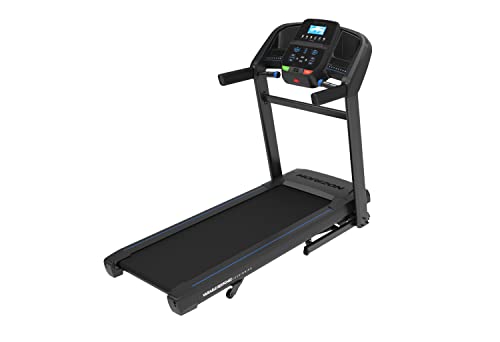 Horizon Fitness
Horizon T202 Treadmill
FeatherLight fold, dial controls, and a 60-inch belt at a mid price.
- Motor: 2.75 CHP (Johnson Drive System)
- Speed range: 0.5-12 mph
Sources: Horizon Fitness T202 product documentation, Amazon listing specifications
Check price on Amazonor add to your Amazon cartOur recommendation
The neatest fork in the folding market. The Carbon T7 sells coaching and convenience; the T202 sells running room and independence. Class households, take the ProForm. Self-directed runners, take the Horizon and its five extra inches of belt.
Belt vs screen
Sixty inches and a dial console against fifty-five inches and a 7-inch touchscreen. Neither machine is better in the abstract; they are better for different training personalities, and owners rarely cross-shop back once they know which they are.
Cost over time
The T202's price is the whole price. The T7's grows by a membership each year you keep the classes. Compare five-year totals before the sticker decides for you.
Ownership in year three: upkeep and expiry
Stretch the ownership horizon and a difference appears that the spec sheet cannot show. Mechanically the two machines ask similar things: belt care on decks of 55 and 60 inches, hinge and latch attention because both fold, dust kept away from motors. The divergence is in what can expire. The T202's console is LED windows and dials; there is no account attached to it, no library that can be withdrawn, no interface that a lapsed payment can dim. In ten years it will do exactly what it does on delivery day. The T7's console is a service wearing a screen. With the membership current, it is the richer machine by a distance; let the membership lapse and the hardware remains, but the experience the price assumed does not. Neither answer is wrong, and this is not a warning so much as a budgeting fact: the T202's cost curve is flat, while the T7's is a subscription-shaped line that must be re-decided every year. Buyers who know they will still be training in year three should choose based on which of those curves matches how they actually keep habits, because the machines will both still fold, and both will still run.
Year three also separates their daily frictions. The T7 greets manual workouts with iFIT prompts some owners find annoying every single session, a small tax that compounds across hundreds of starts, while its membership question returns annually whether the classes still earn it. The T202's recurring irritations are physical and cheaper: a tablet holder that wobbles at running speeds, answered once with a separate stand, and speakers that serve podcasts better than music. Assembly memory fades differently too. The T7's bulky two-person start is a story owners tell once; the T202's praised setup guides make its first day the easier one. Add the quiet spec gaps, the T202's 325 lb capacity and 12 percent incline against the T7's 300 lb and 10 percent, and the long view is consistent: the ProForm charges rent in money and prompts, the Horizon charges a little bench space and a stand.
Who should skip both
Three buyers should pass on this pair entirely. Heavy or very tall runners, first: capacities of 300 and 325 lb and belts of 55 and 60 inches serve the middle of the market well, but the runner who needs a 22 inch wide deck or a 350 lb rating is shopping one tier up, where the heavy-duty folder in our guide lives. Flat-storage households, second: both of these machines fold upright and stand tall doing it, so a home whose only storage is beneath a bed needs the flat-fold pattern instead. And low-ceiling folders, third: an upright fold claims vertical room in exactly the low basements where folding treadmills are usually wanted, and no assist mechanism negotiates with a joist.
Choose ProForm Carbon T7 Smart Treadmill if…
- Trainer-led classes will drive your consistency
- You fold after nearly every session
- You are comfortable at a 55-inch stride room
Choose Horizon T202 Treadmill if…
- You run your own programs
- Tall users need the 60-inch belt
- You want zero ongoing costs
FAQ
Folding Treadmills questions, answered straight
Which folds easier?
Both assists are owner-praised. The T7's lowering feels more damped; the T202's lift feels lighter. Either is a one-person routine.