Fix it
Weight Bench Form Mistakes: The Setup Errors That Steal Your Press
Weight bench form mistakes and how to fix them: feet dangling, lying across the pad gap, skipping the seat angle, loading past the incline rating, a ladder one tooth off, and uncontrolled dumbbell kick-ups.
The bench is the quietest piece of equipment in the gym and the one most lifters set up wrong. A bench that is too high, a pad gap under the hips, a seat left flat on a steep incline, or a ladder one tooth off the seat will steal pounds from every press and add aches the lifter blames on the program. None of these is a strength problem; all of them are setup problems, and all of them are fixable before the first rep. The adjustable bench troubleshooting guide covers what goes wrong with the bench itself, wobble, ladder play, sliding pads, and squeaks. This page is about the body on the bench. The benches underneath it all are ranked in our best adjustable weight benches guide, with the heavy-lifting angle in the heavy lifting guide and the selection logic in the buying guide.
Pressing with feet dangling
Your feet hang off the floor or only the toes touch, so the legs cannot drive and the lower back arches without support. Bench height decides this: most lifters work in the 17 to 18 inch band, and the benches in this guide sit inside it, the REP AB-3100 Adjustable Bench V3 at 17.5 inches to the top of the pad in the flat position, the Flybird Adjustable Weight Bench at about 17.5 inches, the Yoleo Adjustable Weight Bench at about 17.7 inches, and the Body-Solid GFID225 at about 18 inches. Sit on the bench with your pressing stance before buying or before the first set: feet flat, knees comfortable, lower back able to arch naturally. If the feet dangle, a mat under the feet is the honest fix, not a taller stack of plates, and a bench outside your height window will be felt on every set of every pressing session.
Lying across the pad gap
The two-piece pad junction falls exactly under your hip hinge, so every press rocks across a seam instead of a flat surface. Lie where you would press and notice where the junction falls relative to your hips before the set starts: a gap under your lower back is trivia, a gap exactly at the hip hinge is an annoyance you will meet weekly. Longer pads serve tall lifters, and the Fitness Reality 2000 Super Max XL carries an extra long pad design with a backrest about 48.5 by 12 inches, while the REP AB-3100 Adjustable Bench V3 carries a back pad about 11.75 inches wide in a textured vinyl surface. If the gap lands wrong on your bench, shift your position a few inches toward the head end or the foot end until the junction clears the hinge, and check it again whenever the angle changes.
Skipping the seat angle on steep incline
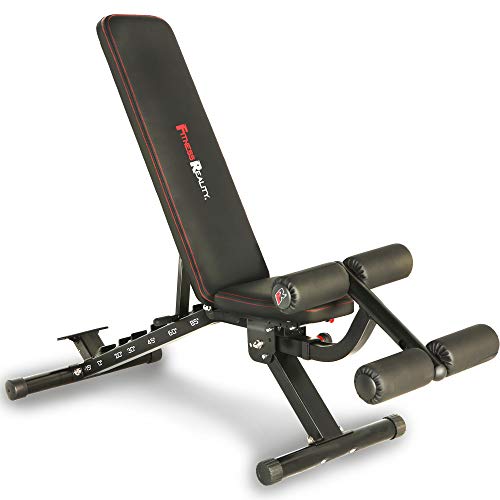
You set a steep incline, leave the seat flat, and slide down the pad through the whole set, because gravity has nowhere else to send you. The seat section exists for exactly this: raise it whenever you train above 45 degrees, so the seat catches your hips and the press stays over your chest. The REP AB-3100 Adjustable Bench V3 gives you 3 seat angles, the Titan Fitness Elite Series Adjustable FID Bench gives you 4 seat positions, and the Flybird Adjustable Weight Bench, the Yoleo Adjustable Weight Bench, and the PASYOU Adjustable Weight Bench each give you 3. Set the seat first, then the back, and test the position unloaded before you load the dumbbells: if you slide, the seat is still too flat, not the pad too slick.
Loading past the incline rating
You read the headline capacity and load the bench past what its incline position is actually rated for. Ratings are often stated for the flat position only, and incline ratings are sometimes much lower: the Titan Fitness Elite Series Adjustable FID Bench is rated 1,000 lb flat and 500 lb incline, which is the clearest example in this guide. Do the capacity math honestly: your bodyweight, plus the total weight in your hands or on the bar path above the bench, plus a margin for the dynamic moment you sit down loaded. Compare that number to the rating for the position you are actually using. Mid tier benches in the 700 to 850 lb band, like the REP AB-3100 Adjustable Bench V3 at 700 lb and the Fitness Reality 2000 Super Max XL at 850 lb, cover nearly every home lifter honestly, but only when the rating matches the angle.
Setting the ladder one tooth off
You set the incline, the ladder looks seated from above, and the bench wobbles under load, because the ladder is riding high on one side. This is the pre-lift check, not a repair: before loading, look at both sides of the ladder, confirm the tooth is fully seated in its notch on each side, and reseat it under the pad's own weight if either side looks high. Incline loads the ladder joint in a way flat pressing does not, so a tooth that is fine flat can fail at 45 degrees. The troubleshooting guide covers ladder play that survives reseating, which is wear rather than setup, but most wobble is this check skipped, and it takes five seconds.
Kicking dumbbells up uncontrolled
You swing the dumbbells up from the floor with straight arms and momentum, and the shoulders take the whole load before the press even starts. The kick-up is a skill: dumbbells resting on the knees, feet planted, a controlled rock back that carries the weights to the chest in one smooth motion, with the elbows tucked and the press starting only once the weights are stable. Bench height matters here too: a bench in the 17 to 18 inch band lets the knees do the work, while a bench that is too high turns the kick-up into a heave. Practise the kick-up with light dumbbells until it is boring, because the heavy set is the wrong time to learn it, and a failed kick-up is how shoulders get hurt before the working weight is even in position.
Pressing heavy alone with no bail plan
You set up a heavy barbell press alone on a flat bench with no safeties, no spotter, and no plan for a failed rep, which turns a normal miss into an emergency. The honest fixes are simple: press heavy with dumbbells when alone, because a failed dumbbell rep can be lowered to the floor in a controlled way, or press inside a rack with safeties set, or train with a spotter for the heavy sets. Know the bail before the set starts, not during it: where the weight goes if the rep fails, and how you get out from under it. The bench is not the safety device; the plan is. If the plan is missing, the weight is too heavy for the setup, whatever the capacity rating says.
Training on a half-latched folding bench
You unfold a folding bench, set the angle, and start pressing without checking that every latch and hinge is fully engaged, so the frame shifts under load mid set. Folding benches earn their storage, the Flybird Adjustable Weight Bench folds to a slim profile about 9 inches thick and the Body-Solid GFID225 folds flat for storage, but the fold is a joint, and a joint that is half latched is a moving part. After unfolding, check every latch and hinge by hand, load the bench with bodyweight first, and confirm nothing shifts before the dumbbells come out. A bench that moves under bodyweight will move more under load, and the fix is thirty seconds of checking, not a stronger frame.
Still stuck? Compare the current top picks
Full ranked list

FAQ
Adjustable Weight Benches questions, answered straight
What bench height is right for pressing?
Most lifters work in the 17 to 18 inch band to the top of the pad in the flat position. Sit on the bench with your pressing stance: feet flat, knees comfortable, lower back able to arch naturally. The REP AB-3100 Adjustable Bench V3 at 17.5 inches, the Flybird Adjustable Weight Bench at about 17.5 inches, and the Body-Solid GFID225 at about 18 inches all sit inside that band. If the feet dangle, a mat under the feet is the fix.
Is the Titan 1,000 lb rating real?
Yes, flat. The Titan Fitness Elite Series Adjustable FID Bench is rated 1,000 lb flat and 500 lb incline, so the headline number belongs to the flat position only. Read the rating for the position you are actually using, and do the capacity math with your bodyweight plus the load plus a margin, before trusting any headline figure.
How wide should a bench pad be?
Standard pads run about 11 to 12 inches wide and support the shoulder blades while letting the arms move. The REP AB-3100 Adjustable Bench V3 carries a back pad about 11.75 inches wide, and the Flybird Adjustable Weight Bench is about 12 inches wide. Longer pads serve tall lifters; wider pads serve dedicated flat pressers.
Do I need the seat section on incline?
Yes, above 45 degrees. The seat section catches your hips and stops the slide down the pad, which is why the REP AB-3100 Adjustable Bench V3 gives you 3 seat angles and the Titan Fitness Elite Series Adjustable FID Bench gives you 4 seat positions. Set the seat first, then the back, and test the position unloaded.
Can a folding bench hold heavy pressing?
Yes, if it is latched and rated for the load. Check the capacity for the position you are using, then check every latch and hinge by hand after unfolding, and load the bench with bodyweight before the dumbbells come out. A folding bench that is fully latched and honestly rated is a pressing bench; one that is half latched is a moving part.