In-depth review
KingSmith WalkingPad A1 Pro Review for Weight Loss Programs (2027): The Program That Happens at Work
Research review of the WalkingPad A1 Pro as program equipment: accumulated daily volume, walking-pace duty, folded storage.
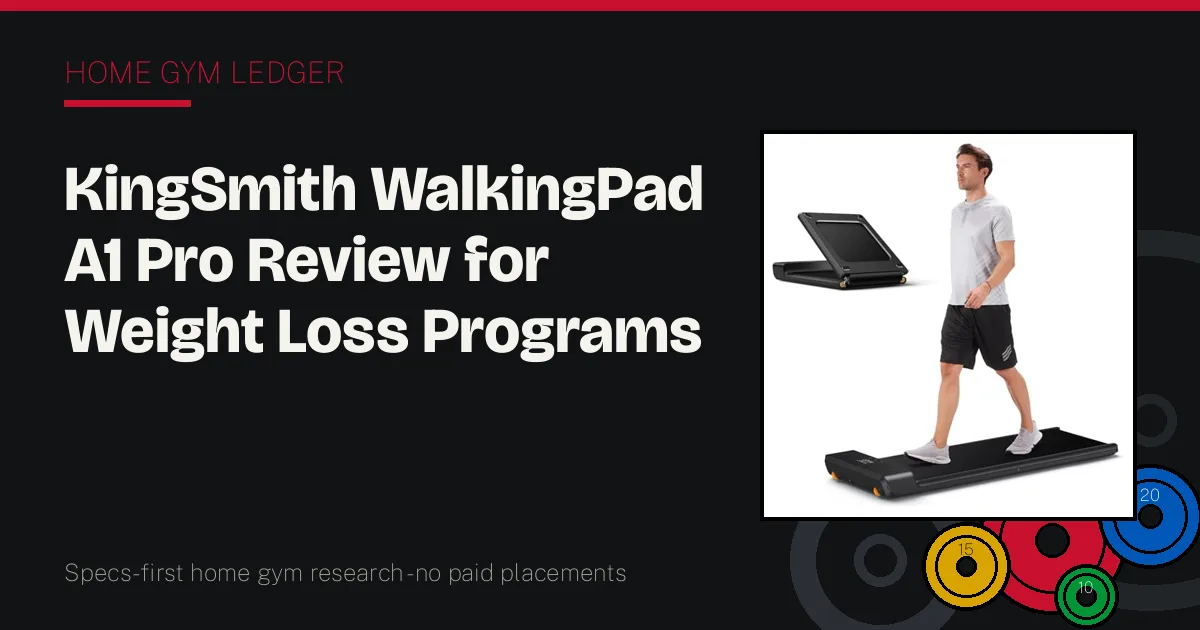

KingSmith WalkingPad A1 Pro Folding Treadmill
Walking volume woven into the workday: the adherence machine for people who will not schedule workouts but will take calls.
- 0.5-3.75 mph, walking only
- Speed range
- Walking gait at walking pace; low impact, spread along a low deck
- Impact profile
- About 56.9 x 21.4 x 5.1 in unfolded
- Footprint in use
Our verdict
Most program equipment competes for an hour of your day. The A1 Pro declines to compete and instead annexes the hours you already spend standing and sitting at a desk, converting them into walking volume at up to 3.75 mph. As a program strategy that is quietly radical: no scheduling, no changing clothes, no session to skip, just accumulation, folded away at night. Its limits are the design's honesty: walking pace only, no incline, belt care on a schedule. Buyers whose programs died of calendar congestion will recognize this as the first machine designed for their actual failure mode. Buyers who love a workout should buy a workout machine and let this one serve its own people.
What we like
- Fits under a standing desk, so program minutes accumulate during work instead of competing with it
- Walking pace is the lowest-impact motorized training a floor and a pair of joints can be offered
- Folds in half and stores flat, so the machine survives in small homes where programs go to die of inconvenience
What to watch out for
- No incline and no handrail in the base configuration
- Belt centering is a recurring small maintenance chore
Who it is for
Desk workers building a program on accumulated daily movement, especially anyone whose scheduled workouts keep losing to their calendar.
Accumulation as a training design
The A1 Pro's program is measured in the day, not the session: walking during calls, during reading, during the standing hours that desk work already contains. Owners describe the shift in exactly those terms, from finding time to using time that was already theirs. For adherence research in the real world, that design beats intensity arguments, because the best-attended session is the one embedded in a routine that was happening anyway.
Pace, posture, and the honest ceiling
The range is 0.5 to 3.75 mph: a deliberate walk at the top, a thinking pace at the bottom. There is no incline to add and no handrail to hold in the base setup, so balance and desk height are part of the fit. Users should verify the current listing's user capacity for the exact revision, and anyone unsteady on their feet should treat a rail-equipped machine as the correct category instead.
Duty across a working day
Spread-out use is this deck's native pattern, and it suits the motor's design life well. Long continuous sessions at top speed warm the motor area, and owners who walk in workday blocks, the intended pattern, report the happiest ownership. Keep the belt centered with the manual's adjustments and the deck swept clean, and the daily routine stays a routine.
Storage as program insurance
Folded in half to a panel about 5-6 in thick, the A1 Pro survives in homes where a permanent treadmill would be resented into a resale listing by February. Programs die of environment as often as of effort, and a machine with a genuine storage home is insured against the most common environmental cause. Measure your under-bed or behind-door slot first, as this hub repeats everywhere, and the insurance is real.
Key specifications
- Speed range
- 0.5-3.75 mph, walking only
- Impact profile
- Walking gait at walking pace; low impact, spread along a low deck
- Footprint in use
- About 56.9 x 21.4 x 5.1 in unfolded
- Folded size
- Folds in half to roughly half its length at about 5-6 in thick
- User capacity
- Check the current listing capacity for the exact revision before ordering
What owners report
Commonly praised
- Owners credit it with the first exercise habit that survived a full season, because it asks for no scheduling
- Quiet enough for calls, per consistent owner reports
- Folded storage keeps it in the home instead of in a resale listing
Common complaints
- Long top-speed sessions warm the motor area; duty awareness matters
- Heavier than it looks on stairs
- App pairing can be fiddly at first setup
Recurring themes from owner reviews on retailers and forums, summarised by our editors. Updated October 2026.
Sources: KingSmith WalkingPad A1 Pro product documentation, Amazon listing specifications
Also consider
 DeskCycle
 2 Under Desk Cycle
Pedaling that hides inside a workday: the smallest possible unit of program, repeated without a decision.
- Resistance: Magnetic, 8 calibrated settings per the manufacturer
- Impact profile: Seated, zero-impact, feet on pedals throughout
Sources: DeskCycle 2 product documentation, Amazon listing specifications
Check price on Amazonor add to your Amazon cartChoose the DeskCycle if you sit rather than stand at your desk; it is the same accumulation strategy in a seated format.
 Schwinn
 IC4 Indoor Cycling Bike
A magnetic bike with 100 resistance levels: the session you can repeat daily because nothing about it punishes you.
- User capacity: 330 lb maximum user weight per the manufacturer specification
- Drive and resistance: Belt drive with magnetic resistance, 100 levels
Sources: Schwinn IC4 product documentation, Amazon listing specifications
Check price on Amazonor add to your Amazon cartChoose the IC4 if your program needs deliberate, harder training sessions and walking volume alone will not satisfy it. Read our Schwinn IC4 Indoor Cycling Bike review
Research-based assessment: manufacturer specifications and documentation, cross-checked against retailer listings and recurring themes in published owner feedback. We do not claim hands-on testing we have not performed, and we make no claims about weight outcomes.
FAQ
Home Gym for Weight Loss questions, answered straight
Can walking at a desk really anchor a program?
It can anchor the movement layer of one: daily, frequent, low-impact volume that happens without scheduling, beneath any deliberate sessions you add. This guide ranks it on that adherence logic and on its specifications, and promises no particular outcome from any pattern of use.
What desk setup does it need?
A standing desk or riser with clearance for the low deck plus your height in shoes, and a chair plan for sitting breaks. Check the deck's dimensions against your desk's footprint and your room's walking lane before ordering.
How does it handle being used by two people in a household?
Programs on shared equipment work when the settings ritual is simple, and here it is: speed by remote or app, per user, in seconds. The shared constraint is the calendar, not the machine, and a deck that lives under one desk usually ends up serving the household around that desk's hours.