Buying guide
Premium Yoga Mat Buying Guide (2027): Materials, Millimetres, and the Size Most Listings Bury
How to buy a premium yoga mat: choose the surface material by practice and care tolerance, match thickness to your session mix, size the mat to your body.

Choose the material by practice and by temperament
Start with two honest answers: how damp do your hands get, and how careful are you with gear? Damp hands in flowing or warm practice point to polyurethane or cork. Careful owners who store gear properly can enjoy natural rubber's immediate grip for years. Owners who want to wipe a mat down and forget it should buy closed-cell PVC and accept its break-in. The material decision quietly includes a care contract, and signing the wrong one is how premium mats become disappointments.
Match thickness to your session mix
Read your last month of practice. Floor-heavy sessions with long holds reward 5 to 6 mm of dense cushion. Standing and balance-heavy work rewards the connection of 4 to 4.7 mm. Mixed weeks live happily at 5 mm. Density matters as much as depth: a firm 5 mm mat supports better than a soft 6 mm one, which is why this guide names density alongside every thickness figure.
Top picks from our research
Full ranked list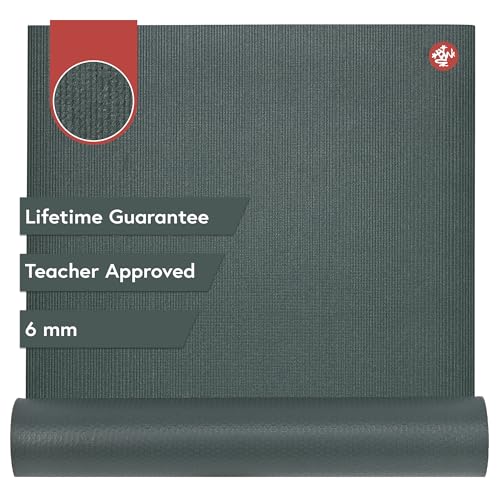


Size the mat to your body, not the average
Standard sizes assume average height and a contained practice. If your hands land past the end in prone positions or your stance runs wide, buy the long or wide version of the mat you chose rather than adapting your practice to a rectangle. Several mats in this guide offer those versions, and the price step is small against years of daily geometry.
Price the whole ownership
A premium mat's real cost includes its care products, a bag or strap if it travels, and its realistic service life in your practice style. A polyurethane mat replaced sooner can still be the right buy for heated practice; a PVC mat that serves a decade is cheap per year by any arithmetic. Compare cost per year of your actual practice, not sticker against sticker.
Read care and guarantee terms as specs
Makers publish cleaning restrictions, storage warnings, and guarantee terms because materials differ, and those documents predict your ownership experience as reliably as thickness does. A guarantee written for a mat's material class is a confidence signal. Care rules you know you will break are a specification you fail, and the honest response is choosing a more forgiving material.
FAQ
Premium Yoga Mats questions, answered straight
What thickness do most practitioners end up happiest with?
The 4.7 to 5 mm middle is the most common long-term answer in owner feedback for mixed practice, with 6 mm winning floor-heavy home practice and 4 mm winning grip-first and travel use.
Is a premium mat worth it over a basic foam mat?
For daily practice, yes, on grip consistency, cushion quality, and service life. For occasional gentle sessions, a basic mat plus props can be the rational spend, and this guide's premium case rests on frequency.
How do I know if I need a long or wide mat?
Practise your full routine on your current mat and note where hands, feet, or elbows land off the surface. One regular overflow point is enough evidence; size versions exist precisely for your measurements.